
PLAYBOOK
Caregiver’s Complete Handbook
The Caregiver’s Complete Handbook & Resource Guide
A Curated Collection of Insights and Best Practices from Fieldworker.ai
Introduction: Your Guide to a Demanding and Rewarding Field
Welcome to The Fieldworker’s Complete Handbook.
This guide is more than just an overview; it is a deep dive into the most critical aspects of the modern social care sector. The role of a fieldworker is one of profound importance, requiring a unique blend of empathy, resilience, and strategic thinking. As the landscape of care continues to evolve, driven by demographic shifts, technological innovation, and regulatory changes, the need for well-informed and well-equipped professionals has never been greater.
In this handbook, we have compiled and curated a collection of in-depth articles from the Fieldworker.ai blog. Each chapter presents the full content of a blog post, allowing you to immerse yourself in the topic and gain a comprehensive understanding. We will move from the macro-level trends shaping our industry to the micro-level skills that define excellence in daily practice. This is your resource for building knowledge, refining your skills, and reaffirming your commitment to the vital work of social care.
Part 1: The Evolving Landscape of Social Care

This section explores the fundamental forces shaping the social care industry. Understanding these demographic and regulatory trends is the first step toward effective and forward-thinking practice.
Chapter 1.1: The Future is at Home: Understanding the Surge in Demand for Home Care
It’s a quiet revolution, happening in living rooms and at kitchen tables across the country. The center of gravity for senior care is shifting, moving away from institutional settings and firmly toward the home. This isn’t just a trend; it’s a fundamental reshaping of the care landscape, driven by powerful demographic forces and the deeply personal preferences of a generation.
The Silver Tsunami is Here
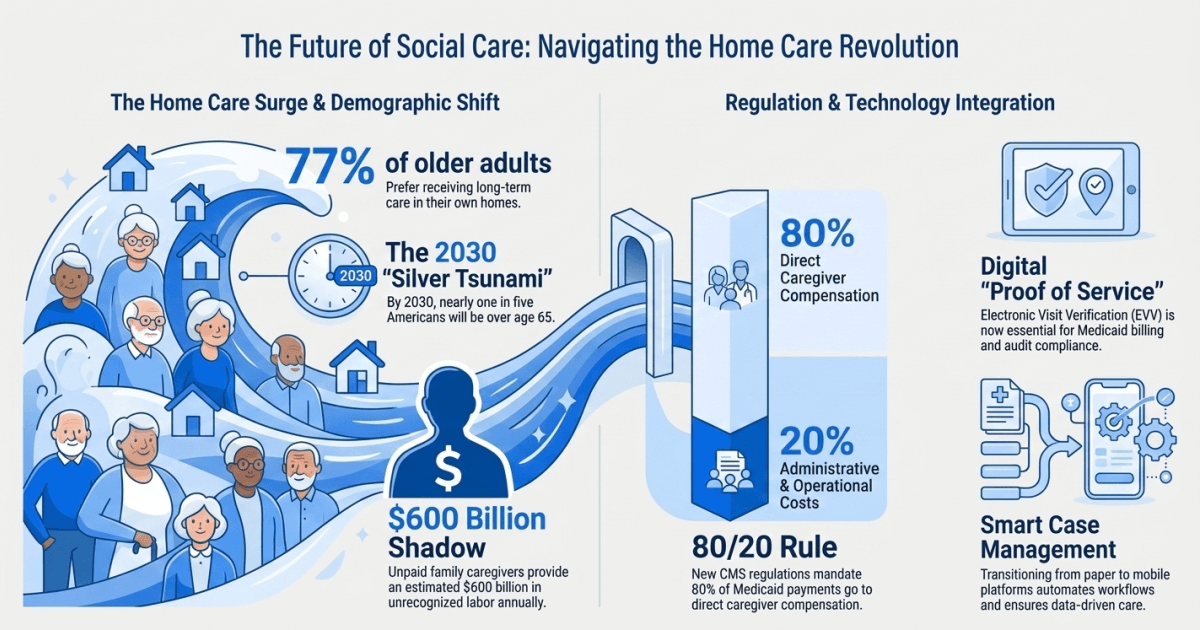
By 2030, an unprecedented milestone will be reached: nearly one in five Americans will be over the age of 65. This “silver tsunami” is no longer a distant forecast; it is our current reality. As the Baby Boomer generation ages, the demand for care services is exploding. But they aren’t just looking for any care-they are looking for care that respects their autonomy and allows them to age in place.
Data from recent surveys is overwhelmingly clear: a staggering 77% of older adults want to receive care in their own homes. The reasons are both practical and emotional. The home is a place of comfort, of memories, of identity. It represents independence and a connection to a community. For this generation, the clinical, impersonal nature of a nursing home is a fate to be avoided at all costs.
The Implications for Providers
This surge in demand creates both a massive opportunity and a significant challenge for home care agencies. The market is growing, but so is the pressure to find qualified caregivers, manage complex logistics, and maintain the highest standards of care. Agencies that can adapt to this new reality will thrive, while those stuck in old models will struggle to keep up.
The key challenges include:
This is where strategy and technology become critical. Successful agencies are investing in robust training programs, offering competitive wages and benefits, and leveraging technology to streamline operations and improve communication. The future of senior care is at home, and the agencies that understand and embrace this reality will be the ones to lead the way.
Chapter 1.2: The $600 Billion Shadow: Recognizing America’s Unpaid Caregivers
In the vast economy of the United States social care system, there is a sector worth an estimated $600 billion. It operates 24 hours a day, 7 days a week. Its workforce is millions strong. Yet, it doesn’t show up in our GDP, and its laborers are often unpaid, unrecognized, and unsupported. This is the economy of family caregiving.
Families are the bedrock of care in America. They are the spouses, children, and friends who provide the daily, essential support that allows millions of individuals with chronic conditions, disabilities, and age-related needs to live in their communities. They perform complex medical tasks, manage medications, provide transportation, and offer the emotional support that is so crucial to well-being.
A System Under Strain
While the dedication of these unpaid caregivers is immense, the system is showing signs of strain. The demand for caregivers is projected to “skyrocket” in the coming years, a direct result of the aging population. This demographic pressure is creating a caregiver gap, where the number of people needing care is rapidly outpacing the number of family members available to provide it.
This has profound consequences:
Moving Forward: The Need for Support
Recognizing the immense contribution of unpaid caregivers is the first step. The next is to build a system of support that sustains them. This includes initiatives such as:
The $600 billion contribution of unpaid caregivers is not a subsidy we can take for granted. It is a vital part of our social fabric that requires investment, support, and recognition.
Chapter 1.3: A New Era of Equity: Phasing Out Section 14(c) and Ensuring Fair Wages
For decades, Section 14(c) of the Fair Labor Standards Act has cast a long shadow over the disability community. Enacted in 1938, this provision allows certain employers to obtain special certificates to pay workers with disabilities a subminimum wage, often just pennies on the dollar. While originally intended to encourage employment opportunities, it has become a symbol of an outdated and inequitable system.
Now, a new era is dawning. The U.S. Department of Labor has announced a proposal to phase out Section 14(c), a landmark move that champions competitive, integrated employment and fair wages for all.
The Problem with Subminimum Wage
The core issue with Section 14(c) is that it perpetuates segregation and underestimates the capabilities of individuals with disabilities. It funnels workers into sheltered workshops, where they perform menial tasks with little opportunity for advancement or integration into the broader community. This model is based on the flawed assumption that people with disabilities are inherently less productive and therefore do not deserve the same wage protections as their non-disabled peers.
Advocates have long argued that this is a civil rights issue. Paying a person less for their labor simply because they have a disability is discriminatory. It devalues their work, limits their economic independence, and reinforces harmful stereotypes.
The Shift to Competitive, Integrated Employment
The movement to end Section 14(c) is part of a broader push toward “competitive, integrated employment.” This model emphasizes that individuals with disabilities can and should work in mainstream jobs, alongside their non-disabled colleagues, earning the same wages and benefits.
This is not a theoretical ideal; it is a proven success. With the right supports-such as job coaching, assistive technology, and reasonable accommodations-individuals with even the most significant disabilities can thrive in the competitive workforce. They become taxpayers, consumers, and active members of their communities.
The phasing out of Section 14(c) is a monumental step forward. It signals a commitment to a future where employment is a pathway to independence and dignity for everyone, regardless of ability. For social care providers and fieldworkers, this shift requires a renewed focus on vocational training, job placement, and employer education to ensure that every individual has the opportunity to achieve their full potential.
Part 2: The Practitioner’s Toolkit: Mastering the Craft of Fieldwork

This section transitions from the broad landscape to the essential, on-the-ground skills that every fieldworker needs. Excellence in social care is built on a foundation of solid methodology, meticulous documentation, and creative problem-solving.
Chapter 2.1: The Blueprint for Success: Mastering Social Work Case Management
At its heart, social work case management is the art of guided care. It is the structured, systematic process by which a fieldworker helps a client navigate the often-bewildering maze of social services to achieve their goals. It is both a science and an art, requiring a blend of organizational prowess, clinical skill, and deep empathy. With the number of social workers in the USA expected to climb to nearly 790,000 by 2026, mastering this core competency is more important than ever.
The Core Functions of Case Management
Effective case management can be broken down into several key functions:
The Goal: Empowerment and Self-Sufficiency
Ultimately, the goal of case management is not to create dependency, but to foster empowerment. A successful case manager works with the client, not for them, building their capacity to navigate systems, advocate for themselves, and eventually manage their own needs independently. It is about providing the tools, support, and guidance that allow an individual to move from a state of crisis to a state of stability and self-sufficiency.
Chapter 2.2: ‘If It’s Not Written, It Didn’t Happen’: The Definitive Guide to Case Notes
In the fast-paced world of social care, it’s a phrase that every practitioner knows by heart: “If it’s not in the record, it never happened.” This isn’t just a bureaucratic red tape; it is the golden rule of professional practice. Your case notes are the single most important tool for ensuring continuity of care, demonstrating compliance, and protecting both your client and your agency. And yet, a recent survey delivered a startling finding: 6 out of 9 care providers admit they struggle to update their case notes regularly. This is a critical gap that can lead to poor outcomes, failed audits, and legal liability. It’s time to elevate the art of the case note.
Why Good Case Notes are Non-Negotiable
The Anatomy of an Excellent Case Note
A good case note is objective, concise, and relevant. While formats may vary by agency, every note should contain some key elements:
Embrace Technology
The days of scribbling illegible notes on a paper chart are over. Modern case management software allows you to enter notes from the field using a tablet or smartphone, use templates to ensure consistency, and securely store your records. Embracing this technology is not just about convenience; it’s about elevating the quality and professionalism of your documentation.
Chapter 2.3: 5 Effective Strategies for Solving Care Center Challenges
Running a community or day care center is a balancing act. You are tasked with creating a safe, engaging, and supportive environment for your clients while simultaneously managing staff, navigating regulations, and balancing a tight budget. It’s a rewarding mission, but one that comes with a unique set of challenges. Here are five effective strategies to help your center not just survive, but thrive.
Running a care center will always have its challenges, but by focusing on these core strategies, you can create a more efficient, effective, and joyful environment for everyone.
Part 3: Technology and the Future of Care

Technology is not a replacement for the human touch in social care, but it is a powerful tool for amplifying its impact. This section explores how innovative software and digital solutions are making care more efficient, compliant, and client-centered.
Chapter 3.1: Making Social Care Smarter: The Impact of Case Management Technology
For too long, the tools of the social worker have been the pen, the paper file, and the overstuffed filing cabinet. But a technological revolution is underway, and it is making social care smarter, safer, and more effective. Modern case management software is no longer a luxury for large agencies; it is an essential tool for any provider looking to thrive in the 21st-century care landscape.
Beyond the Digital Filing Cabinet
The first generation of case management software was little more than a digital filing cabinet-a place to store client data. But today’s platforms are so much more. They are dynamic, intelligent systems that actively support the work of the fieldworker. Key features of modern platforms include:
A Real-World Example: The School Social Worker
Consider the impact on a school social worker. In the past, they might have juggled paper files for dozens of students, struggling to track attendance issues, behavioral incidents, and family contacts.
With a modern case management platform, that same social worker can:
This is not about replacing the social worker; it is about empowering them. Technology is transforming social care by providing the tools practitioners need to work more efficiently, collaborate more effectively, and ultimately, deliver better outcomes for the people they serve.
Chapter 3.2: From Chaos to Compliance: How Software is Revolutionizing Home Care Agencies
The administrative side of running a home care agency can be a chaotic whirlwind of spreadsheets, paper schedules, and billing forms. In a field with a growing elderly population and a chronic shortage of caregivers, especially in heavily regulated states like New Jersey, inefficiency is not just frustrating-it’s a threat to the viability of the business. This is where compliance and audit software comes in, transforming the back office from a source of stress to a strategic advantage.
The Compliance Tightrope
Home care agencies walk a compliance tightrope. They must adhere to a complex web of state and federal regulations, including Medicaid requirements, labor laws, and licensing standards. A single misstep can lead to failed audits, financial penalties, and reputational damage.
Key compliance challenges include:
Bringing Order to the Chaos
Modern home care software is designed specifically to tackle these challenges. It provides a single, integrated platform for managing the entire operation:
By automating these core functions, home care software allows agencies to move from a reactive to a proactive stance on compliance. It brings order to the chaos, reduces risk, and frees up agency staff to focus on their primary mission: providing excellent care.
Part 4: Navigating the Regulatory Maze
Compliance is a non-negotiable aspect of social care. This section provides a detailed look at two of the most significant regulatory issues facing providers today, offering clarity and actionable advice.
Chapter 4.1: Deconstructing the 80/20 Rule: What HCBS Providers Need to Know
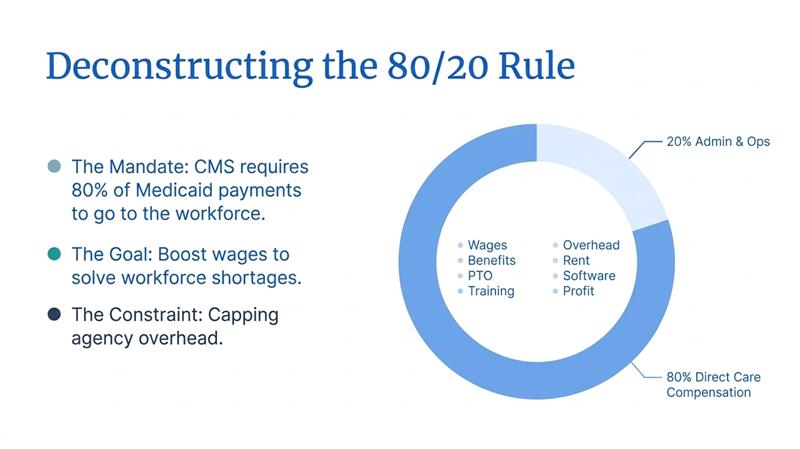
The Centers for Medicare & Medicaid Services (CMS) has finalized a regulation that is set to send ripples across the entire Home and Community-Based Services (HCBS) landscape. Known as the “80/20 Rule,” this provision mandates that at least 80% of Medicaid payments for personal care, homemaker, and home health aide services be spent on compensation for the direct care workforce.
While intended to address the caregiver workforce crisis by boosting wages, the rule presents significant administrative and financial challenges for providers. It’s crucial for every HCBS agency to understand the details.
What Does the Rule Require?
At its core, the rule is simple: for every dollar a provider receives from Medicaid for the specified services, at least 80 cents must go directly to the caregiver.
But what counts as “compensation”? According to CMS, this includes:
The remaining 20% is left to cover all other administrative and operational expenses, such as rent, utilities, billing services, software, supervision, and any profit margin.
The Challenge for Providers
For many providers, meeting this 80/20 threshold will be a major challenge. Agencies in states with lower Medicaid reimbursement rates or those with high administrative overhead may find it difficult to comply without fundamentally restructuring their operations.
Key concerns include:
How to Prepare
Agencies cannot afford to wait. The time to prepare is now.
The 80/20 rule represents a paradigm shift for HCBS providers. Proactive planning and strategic adjustment will be the key to navigating this new regulatory reality.
Chapter 4.2: The Proof is in the Pudding: The Importance of Service Delivery Proofs

In the home care industry, trust is the currency of the realm. Families trust you to care for their loved ones. State Medicaid agencies trust you to deliver the services you bill for. The foundation of that trust is proof-clear, verifiable proof of service delivery. Without it, your agency faces denied claims, costly audits, and a damaged reputation.
Why Proof is Paramount
Accurate service delivery proofs are not just about compliance; they are about integrity. They serve several critical functions:
The Evolution of Proof: From Paper to Pixels
The days of handwritten timesheets and service logs are numbered. These manual systems are prone to error, difficult to audit, and susceptible to fraud. The modern standard for service delivery proof is digital, built on a foundation of EVV and Electronic Health Records (EHRs). A robust digital system captures multiple points of proof:
For home care agencies, investing in a comprehensive digital system for capturing service delivery proofs is no longer optional. It is the cost of doing business. It is the price of trust. And it is the key to building a successful and sustainable agency in the modern era of care.
Conclusion: The Future-Ready Fieldworker
The world of social care is one of constant change and complexity. As we have seen through these articles, the modern fieldworker must be more than just a compassionate helper; they must be a skilled navigator, a meticulous documentarian, a tech-savvy professional, and a tireless advocate.
The challenges are real-from workforce shortages to regulatory pressures. But the tools and strategies to meet these challenges are also real. By embracing technology, committing to best practices, and staying informed about the evolving landscape, we can not only meet the demands of the present but also shape a more effective, equitable, and person-centered future for social care.
This handbook is a starting point. We encourage you to continue learning, continue adapting, and continue your commitment to the incredible work you do. The communities you serve are better for it.